

Democracy in the Digital Era

Ribbon_START

Technology is often referred to as a double-edged sword it can potentially liberate us and enslave us.  We are witnessing the creation of the digital world. Ten years ago, there was no such thing as Facebook. Ten years before that, we didn’t have Amazon or the Web. New technologies have opened up new opportunities. They bring with them an ever more complex reality that is causing certain jobs to disappear and others to emerge.

There are a lot of people in our societies that are in a similar predicament as the factory workers during the Industrial Revolution. If you don’t enter the world of technological progress you may well loose your job and be left behind. The actual work space that was located in certain buildings, in certain regions and countries that caused migration waves in the past tend to disappear and transform into digital spheres where people living in different parts of the planet come together and work for a company with more flexible timetables, salaries and harnessing acute multitasking skills.

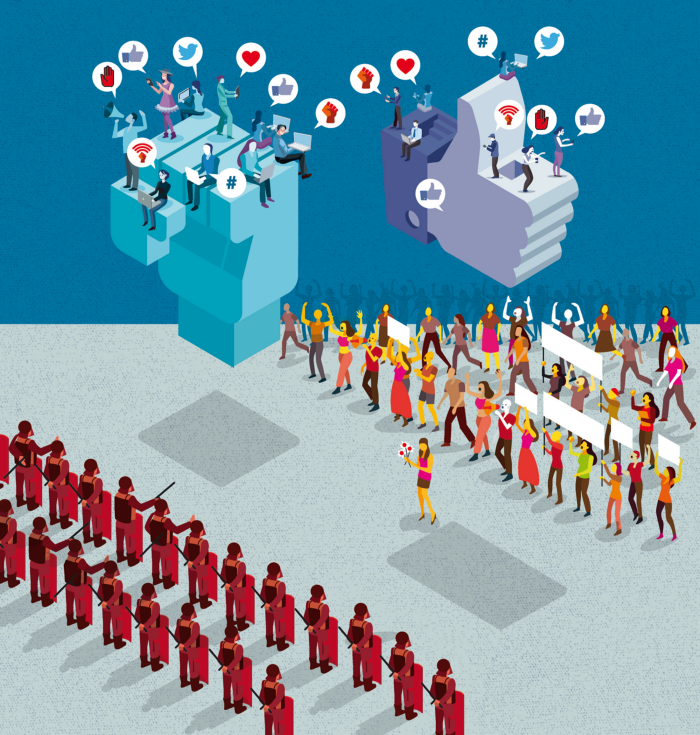
The expansion of geographic boundaries in the digital era affects work as much as the creation of new communities. They are brought together by a common cause which is very often global and transcends nation states. These communities debate, exchange ideas and propose solutions for very complex issues and become fundamental to citizenship democracy. Social Media platforms are essential for the creation of these communities and processes. The news information shared in these networks are of an unprecedented magnitude than ever before. Social Media hashtags have brought to the surface issues that motivated people to protest and demand change.

There are also dubious aspects that should be dealt in those digital spheres concerning the lack of regulatory policies by states and their owners, that would prevent the spread of fake news. The creation of communities with people of similar interests and aspirations that are missing individuals of different opinions, creating groups that work as “echo chambers” as Noam Chomsky describes it. Where more or less the individuals part of a group share the same standpoint of the spectrum thereby excluding individuals with different view points. There are also issues of the effects of technology and the virtual world in the human brain, psychology and cognitive processes.

Besides all these drawbacks of digital technology we have to acknowledge that there is no way back and that there are powerful tools that technology provides that could remodel and enhance the democratic models of our societies. There is a need to create new initiatives for online and offline discussion, deliberation, and debate in diverse communities. Making the digital sphere a more inclusive space that citizens from different age groups, economic and cultural background can participate and promote understanding of the best traditions and diverse experiences of our democracies.
Reducing Distances & Expanding Communities

By now, a world without the internet is unimaginable. Connecting billions of people worldwide, the internet is a core pillar of the modern information society. Almost 4.66 billion people were active internet users as of October 2020, encompassing 59 percent of the global population, while mobile usage has now become the most important channel for internet access worldwide as mobile internet users account for 91 percent of total internet users. With Northern Europe having a 95 percent internet penetration rate among the population.

As the use of digital technology extends to wider parts of the population, it transcends geographic boundaries and create digital spheres that citizens from all over the word participate, with a sense of shared fate, debating and discussing very controversial issues.

The ability for new and different ways to engage and participate politically has expanded by the use of the internet. Not only does this technology allow us to stay abreast of political developments in real time and to connect to our elected representatives instantaneously, it also allows us to find our political tribes—or allows us to create new tribes—and mobilize around issues of shared concern overnight.

We sign petitions, go to rallies, march in protests, donate time and money to causes, and debate online. These activities, which have been episodically part of our political landscape for decades, have gone from being a bug to becoming a feature. Democracy must adapt to be responsive to these feedback mechanisms. Through institutional reform we can harness this participatory impulse in the service of governance and, in so doing, restore the credibility and resilience of a fading political system.

There has been an upsurge of initiatives to help citizens discuss difficult topics  despite  deep  disagreement and to provide opportunities for citizens to better understand each other, disagree constructively, and participate fully in democratic practices.

Social Media

The Women’s March on Washington that took place in January 2017 after President Trump won the US elections, boasted crowds numbering in the hundreds of thousands. The largest single-day protest in U.S. history started with a Facebook post created by a grandmother in Hawaii. To some, the march and its speedy rollout typified the unique possibilities for rapid mobilization that social media affords us. With tools like Facebook and Twitter, disparate groups are able to mobilize faster than ever before.

No man can understand his own argument until he has visited the position of a man who disagrees. – James S. O’Rourke IV, Professor at University of Notre Dame
pexels-kelly-lacy-4570690
me-too-Flickr-gipuzkoa
48764839521_8f0261e305_c(1)
5

Digital media have radically changed the information landscape that was previously owned by large media multinational companies that presented news in favor of the owner’s political affiliations. Through Social Media the choice of news to be shared passed on to ordinary people and in many cases transformed the media platforms into a space of dialogue and deliberation.

We are all still learning how to navigate this new landscape with all its potentials and dangers.

Fake News

We are living through a period of profound economic, technological, social, and cultural changes which together make an increasing number of citizens vulnerable to manipulation by those who seek to blame the “other”  for these misfortunes. Whether it be the elite who rigged globalization in their favor, migrants who pose terrorist threats and have come to steal jobs, or ethnic minorities given special accommodation at another group’s expense, scapegoating and inciting tribalism has become a favored political tactic, particularly among emergent authoritarians and populist leaders.

In many cases other nefarious actors, including hostile states, further inflame partisan and social divides, particularly around elections. Social media has provided powerful tools for these actors to target the vulnerable and deepen divides by exacerbating social fragmentation.

The absence of gatekeepers who are accountable for the quality of information has left the system awash with poor or intentionally misleading information and conspiracy theories. Additionally, the powerful algorithms that distribute information do so in a targeted way, effectively producing a different sense of reality among people of the same community.

One of the many fake stories to be shared by millions claimed Pope Francis was backing Mr Trump (WTOE5 News)

In the aftermath of 2016 U.S. election both Facebook and Google removed fake news sites from their advertising platforms on the grounds that they violate policies against misleading content. Furthermore, Facebook has taken steps to identify fake news articles, flag false articles as “disputed by 3rd party fact-checkers,” show fewer potentially false articles in users’ news feeds, and help users avoid accidentally sharing false articles by notifying them that a story is “disputed by 3rd parties” before they share it.

Fake news sites and articles also raises important questions about who becomes the arbiter of truth.

Activism & Technology

There is an argument that online activism — sometimes referred to as slacktivism, by its critics— might be ineffective or lazy, especially when compared to the efforts of activists in decades past. Sharing a hashtag or retweeting a post might make people feel like they’ve supported a cause when they’ve actually just made a minimal effort. If we consider the speed of communication on the internet with careful organizing, activist efforts organized online can potentially build inclusive, connected movements with a speed and magnitude possibly not accessible — or even imaginable — to earlier generations.

One could argue that the ways in which movements grow online today is similar to how movements grew before the internet, particularly in their reliance to a consistent narrative. “Across historical periods, social movements have relied on public debate, discussion, and storytelling,” Dr. Sarah Jackson argues. The same thing is happening today. In the past they used to distribute pamphlets or write open letters as in the civil rights movement. Today the mediums change and you could have tweets, online petitions, web platforms of political debate. That serve the same purpose to inform and get people involved towards a common goal.

Across historical periods, social movements have relied on public debate, discussion, and storytelling  – Dr. Sarah Jackson Professor at University of Pennsylvania professor
 

The foremost importance of modern technology that could spread a message of a common goal is the power of images. With mobile devices in the palm of our hands we can shoot compelling videos of injustice happening before our eyes and share it with others creating a massive impact and take people out of the virtual sphere to the streets, whether it is the footage of George Floyd’s assassination, or videos of tanks in the streets during the attempt of coup d’etat in Turkey.

Digital Tools & New Democratic Practices

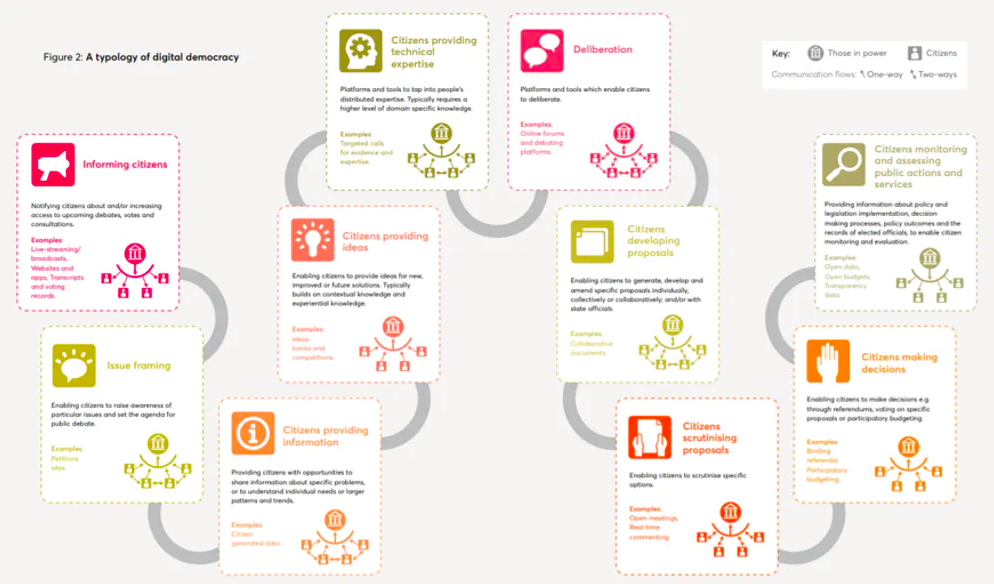
There is growing sense from citizens, stakeholders, entrepreneurs and governments to use digital tools that will transform democratic practices of the past to a more contemporary and inclusive approach that goes beyond casting a ballot vote once, every 4 years. The Coronavirus pandemic has accelerated a move towards online methods of decision-making and digital democracy on a large scale.

A typology of digital democracy, from p13 ‘Digital Democracy: The Tools Transforming Political Engagement’, Nesta (2017).

The tools chosen, and the way in which they are used, will have significant ramifications for the use of digital methods in the long term. Coming out of lockdown, changes to our ways of working, communicating – and thinking – will be inevitable. But what we learn from this time will inform decisions about the use of digital methods as democracies tackle some of the biggest economic, social and health challenges of our time.

Ordinary citizens can be directly involved in the decision-making process. Initiatives such as Ireland’s Citizens’ Assembly, France’s Parlement et citoyens, and Spain’s Decide Madrid, are some examples which show that public participation in important government discussions around constitutional, law-making, budgets and other issues, while potentially tailoring decisions more closely to citizen’s needs and creating a greater degree of consensus.

Further inspiration can be found in Nesta’s 2020 Democracy Pioneers Award from civil society democratic innovators who have been testing and developing many of these tools and approaches.

Dangerous Implications of the Virtual World

The pervasiveness of technology impacts our brains and society’s overall well-being. Issues such as distraction and the digital divide are crucial to how technology has impacted the brain’s ability to develop. Multitasking is thought to be as one of the largest negative effects of technology. Our need to look at multiple screens for a variety of purposes and tasks has affected our ability to learn, reason, and remember because of our inability to truly focus on numerous things at once. Another major concern with technology, is that people are not using technology to create but to consume.

Some of the dangerous implications of the virtual world could be summed up to the following:

  • Vast array of information, inability to choose content.
  • Inability to read in depth a certain subject and form an opinion. Fast pace of life, fast reading, superficial knowledge of an issue.
  • A world of Images and therefore impressions focusing on the emotions part of the human brain and not the intellect which provides a fertile ground of populism.

  • Subjected to a flux of information of others and render thoughts such as, I am not good enough, not rich enough, not happy enough. Therefore create a sense of self-deprecation, loneliness and alienation.
The constant use of technology is hijacking one’s ability to form high-level meaning within their environment. Technology isn’t necessarily the problem, but the way in which we use technology to set expectations and receive validation is where issues can arise.

Communicating with family members across the globe, news information, access to knowledge, may coexist with the need for “likes” on social media. This needs our immediate attention especially in the case of young people as it can impact one’s identity by potentially creating a superficial view of self.

Technology is not going anywhere. In fact the opposite is happening. But as technology continues to become further embedded in our everyday lives so does a better understanding of its effects on our brains and, with that, a better ability to integrate and use technology in positive, meaningful ways.

Education & Social Inclusion in the Digital Age

Digital technologies are an inseparable part of today’s learning process. There are four pillars that need to be addressed, schools, workforce, elderly and impoverished.  The European Commission works on several policy initiatives in order to modernize education and training, provides funding for research and innovation in order to promote digital technologies used for learning and measures the progress on digitization of schools.

The European Commission has adopted on 17 January 2018 the Communication on the Digital Education Action Plan. The Action Plan outlines how the EU can help individuals, educational institutions and education systems to better adapt for life and work in an age of rapid digital change by:

  • Making better use of digital technology for teaching and learning;
  • Developing relevant digital competences and skills for the digital transformation;
  • Improving education through better data analysis and foresight.
The Raspberry Pi Example

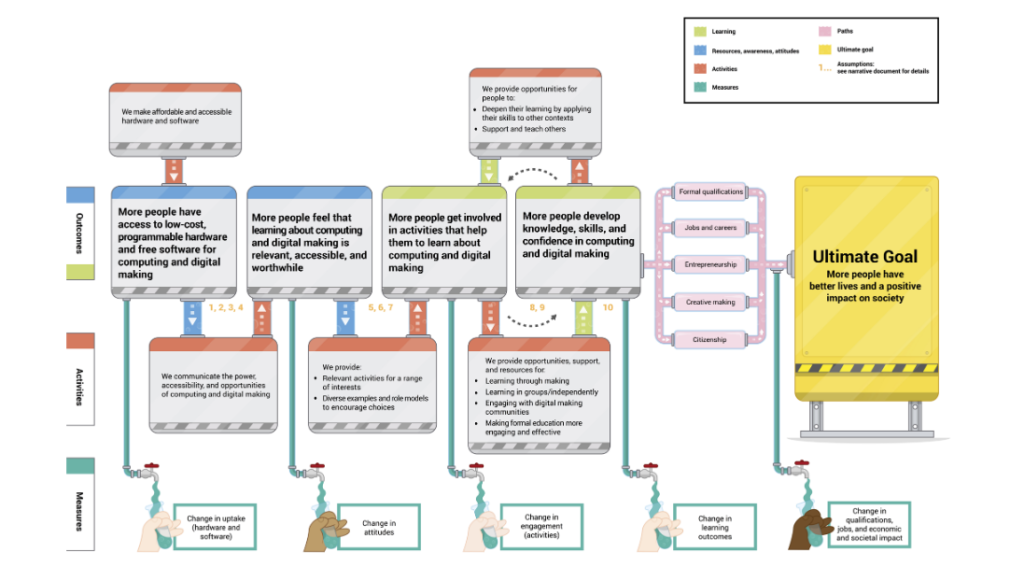
The Raspberry Pi Foundation is a UK-based charity that works to put the power of computing and digital making into the hands of people all over the world. Their aim is to make more people able to harness the power of computing and digital technologies for work and education by providing them the knowledge to solve problems that matter to them and express themselves creatively.

Millions of young people are learning computing and digital making skills through a thriving network of clubs and events, and through partnerships with youth organisations. We enable any school to offer students the opportunity to study computing and computer science through providing the best possible curriculum, resources, and training for teachers. Their effort is essential as they make computing and digital creation accessible to all through providing low-cost, high-performance single-board computers and free software.

Raspberry Pi Theory of Change.